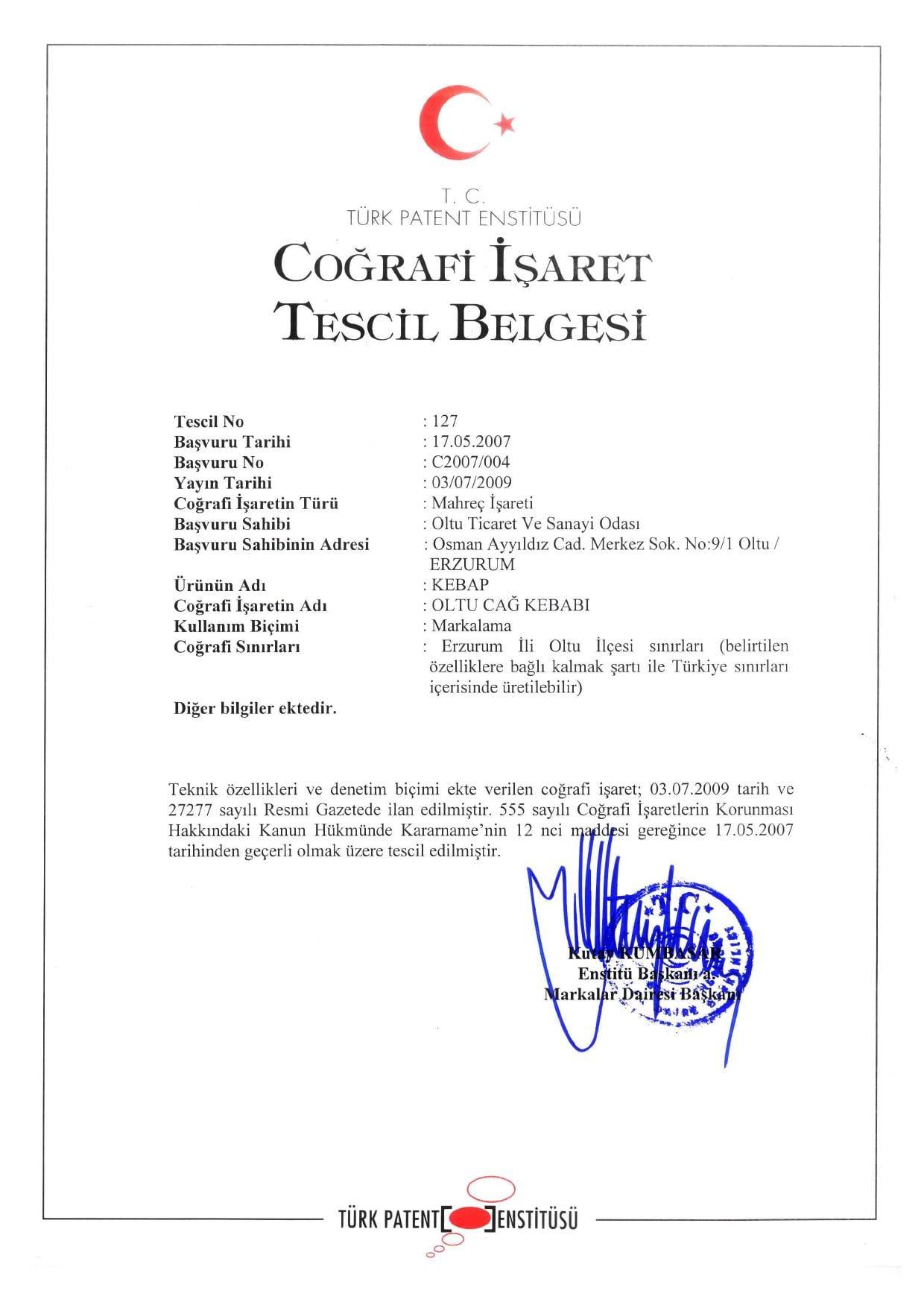
This guide is based on the registration document and the portal record of TÜRKPATENT, the Turkish Patent and Trademark Office. The conditions taken from the registration document apply to “Oltu Cağ Kebabı”; they are not a standard shared by all cağ kebab. Links to the sources are at the end of the page.
The record
Oltu Cağ Kebabı is geographical indication no. 127. It is registered in Türkiye under the mahreç işareti category of geographical indications. The applicant is the Oltu Chamber of Commerce and Industry, application no. C2007/004. The document lists the product as “Kebap” and the method of use as “Markalama” (marking). TÜRKPATENT’s portal shows the record as “Tescilli” (registered).
Application, publication and registration dates
The document and portal give different application dates.
Application: 17 May 2007 in the registration document, 14 May 2007 on TÜRKPATENT’s geographical indications portal. Neither source explains the difference.
Publication: according to the document, the product’s technical specifications and inspection method were published in Official Gazette no. 27277 on 3 July 2009. An İhlas News Agency report of 17 June 2026 gives this as the registration date.
Registration: the portal gives 22 February 2010. The document says the registration was made under Article 12 of Decree-Law no. 555 and takes effect from the application date, 17 May 2007.
The registration date does not show when the dish came about; the document gives no history of who first made cağ kebab or how it spread to other cities.
How the document describes the meat
According to the registration document, the meat comes from sheep from the region, raised on natural feed outdoors or on upland pastures. The production method calls for sheep at least one year old. Sinew, veins and membranes are trimmed away; the meat must have a fat content of 25 to 30 per cent, and any excess fat is removed. The meat is salted and left to rest for a day. Finely chopped onion is mixed with black pepper to form a paste. The meat is then kneaded thoroughly with this mixture. Nothing beyond what the recipe lists may be added.
The document describes the spit as made of “krom”. The part that holds the meat is square, 2 by 2 cm. The size of the meat pieces is adjusted to the length and thickness of the spit.
The hearth, fire and carving
The meat is cooked at a stone or brick hearth fired with fruit wood or oak. The fire is lit half an hour before the spit goes on, and the hearth must be fully heated. The spit is mounted horizontally in front of the fire, 15 cm above the hearth base, at a suitable distance from the heat, and turned as the meat cooks. The document describes doneness as the meat turning from red to brown.
The cooked meat is served on small skewers called “cağ”, or, on request, on a plate without them. The document uses the same material description for the meat-holding section of the cağ. That section is 20 cm long, 2 mm thick and 3 mm wide, with a pointed tip; a wooden handle is preferred. The cağ is pushed through the meat on the spit, and the meat is cut with a kebab knife into slices 4 to 7 mm thick. If requested, the meat on the underside of the cağ is browned on a grill beside the hearth. The document specifies an average serving of 80 g on a cağ, or 100 g for a plated portion without one. Sliced raw onion and, in season, sliced tomato are served on a separate plate.
The history of the name: what the document states
The document refers to a Turkish Language Association dictionary and the Anatolian Folk Cuisine Platform. These references alone do not establish where or when the dish originated.
The dictionary’s current entry for “Oltu kebabı”, and the dispute between Oltu and Tortum over the dish’s origins, are covered with their sources in our guide to cağ kebab.
Who inspects it?
According to the document, compliance with these conditions is inspected by a three-person committee coordinated by the Oltu Chamber of Commerce and Industry: one staff member from Oltu Municipality, one food engineer from Oltu Vocational School and one staff member from the Chamber. The committee inspects once a year as a matter of routine, and at any time when needed or after a complaint. Under the document, the committee initiates legal proceedings against misuse of the geographical indication. The Chamber sends the inspection reports to the Turkish Patent Institute.
What the Chamber announced in 2026
An İhlas News Agency report dated 17 June 2026 (in Turkish) quotes the Chamber as announcing mandatory signage and authorisation certificates for cağ kebab businesses. The report does not explain the legal basis or scope of these requirements.
Can it be made outside Oltu?
The document gives the geographical boundary as the Oltu district of Erzurum province, followed by this condition: the product “can be produced within the borders of Türkiye, provided it adheres to the specified characteristics”. Obligations on using a geographical indication are set separately in legislation.
Serden’s cağ kebab
Our guide to cağ kebab explains which meat we use and how we prepare it.
Sources and links
- Turkish Patent and Trademark Office: Oltu Cağ Kebabı, registration 127 (in Turkish)
- Turkish Patent and Trademark Office: registration document for the Oltu Cağ Kebabı geographical indication, no. 127 (in Turkish)
- İhlas Haber Ajansı, haberler.com, 17 June 2026: “Oltu Cağ Kebabı için yeni dönem: Yetki belgesi ve tabela zorunluluğu geldi” (in Turkish)