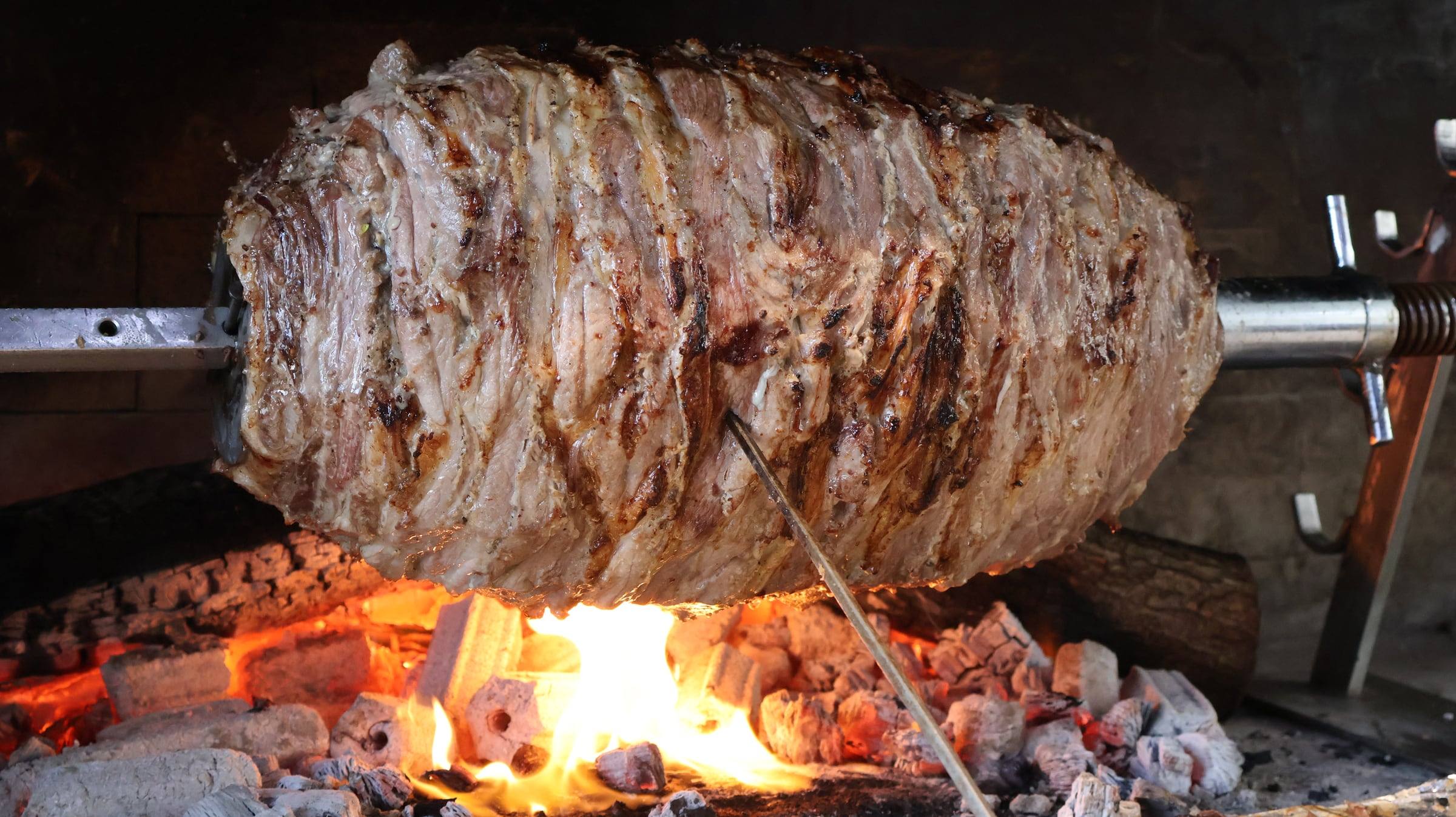
Cağ kebab (in Turkish, cağ kebabı) is a kebab from Erzurum in eastern Turkey, cooked on a horizontal spit. Seasoned lamb or mutton is stacked on a large spit, which is set in front of a wood or charcoal fire and turned as the meat cooks. To serve it, the cook pushes a small skewer called a cağ into the cooked outer layer, then slices the meat away from the main spit so that it stays on the skewer. It comes to the table on these skewers, or on a plate if you prefer. In English it is also written cag kebab.
Where does the name come from?
The dish takes its name from the small serving skewers called cağ. Both the Turkey Culture Portal and the two Erzurum cooks quoted by Kara (2017) give this explanation. Cağ is pronounced roughly “jah”, with the “j” in “jam” and the vowel sound in “father” held slightly longer. The same cooks point out that “çağ kebabı”, with a ç, is a mispronunciation.
The Turkish Language Association’s dictionary redirects cağ kebabı to its entry for Oltu kebabı, which reads, in our translation: “a type of kebab specific to the Oltu area, threaded onto a skewer, roasted horizontally and cut into small pieces”. The entry gives the dish a third name as well: yatık döner, roughly “horizontal döner”.
Where is cağ kebab from?
Cağ kebab is a dish of Erzurum: the Turkey Culture Portal, run by the Ministry of Culture and Tourism, describes it as part of Erzurum’s cuisine. According to Kara (2017), it has been eaten for centuries in the Tortum, Uzundere, Oltu, Olur and Şenkaya districts of Erzurum province and in Yusufeli, in neighbouring Artvin.
The name “Oltu Cağ Kebabı” is registered with TÜRKPATENT, the Turkish Patent and Trademark Office, as a geographical indication, following an application by the Oltu Chamber of Commerce and Industry. We cover the dates and conditions of the registration in a separate guide.
Kara’s 2017 article records a dispute between Oltu and Tortum over the dish’s origins, along with differing accounts of when restaurants began serving it. In an account the article attributes to the Oltu Chamber of Commerce and Industry, cağ kebab restaurants multiplied in the 1960s. The source the article gives for this account is a business’s history page. Kemal Koç, a cağ kebab master in central Erzurum, says he was the first to bring the dish into a restaurant kitchen, in 1982.
These are differing accounts of how the dish came to be served in restaurants; they do not prove when or in which district it originated.
TasteAtlas ranks “Oltu cağ kebabı” fifth in its ratings-based 2025/26 list of the 100 Best Dishes in the World. This is not a ranking or award for Serden.
Which meat is used?
Cağ kebab is usually made with lamb or mutton. The Culture Portal recipe uses lamb leg; Kara’s article recommends leg and shoulder. In the Culture Portal recipe, the leg is cut lengthwise and the meat is removed from the bone. Kara also calls for young sheep raised naturally on the uplands of Erzurum and Kars.
According to Kara, any part of the carcass except the tail can be used. No breed is required: some cooks recommend Kıvırcık sheep, but any breed will do, fat-tailed breeds included. Kara also describes using pasture-fattened goat from July until the breeding season begins.
Kara describes adding beef to balance fattier mutton, using leg or shoulder meat from young cattle; the article does not recommend making cağ kebab from beef alone. The two meats are threaded onto the spit in alternating slices, and the beef may first be marinated in yoghurt, separately from the mutton.
The registered “Oltu Cağ Kebabı” has its own production requirements. According to the registration document, it uses meat from sheep from the region, raised on natural feed outdoors or on upland pastures; the sheep must be at least one year old, and the meat must have a fat content of 25 to 30 per cent.
How is it different from döner?
Cağ kebab is cooked on a horizontal spit and served on small skewers. Turkish regulations also recognise horizontally cooked döner, so the position of the spit does not set the two apart on its own. Turkish regulations classify red-meat döner as sliced, minced or mixed; even the minced category contains at least 10 per cent sliced meat. The cağ kebab recipes in our sources use only pieces of meat. The registered recipe and the Culture Portal use salt, onion and black pepper. Kara also describes marinating the beef separately in yoghurt when beef is added.
Döner is defined in the Turkish Food Codex, in the communiqué on meat, prepared meat mixtures and meat products published in the Official Gazette on 16 September 2026. The communiqué does not define cağ kebab. It excludes kebab dishes from its scope but requires the meat used in them to comply with its provisions.
| Cağ kebab: recipes in the sources | Red-meat döner: legal definition | |
|---|---|---|
| Spit | Horizontal; the spit is turned as the meat cooks (registration document, Turkish Language Association dictionary, Kara). | Horizontal or vertical; the spit rotates as the meat cooks (communiqué, art. 4). |
| Meat | Pieces of meat. The Culture Portal recipe calls for a leg of lamb, boned and cut into pieces sized for the spit. The registration document and Kara’s article specify removing sinew, membrane and excess fat. None of the sources uses mince. | In yaprak (sliced) döner, all the red meat is sliced. In yaprak-kıyma döner, at least 60 per cent of the red meat is sliced; in kıyma (minced) döner, up to 90 per cent may be mince, with at least 10 per cent sliced (communiqué, art. 7). |
| Seasoning | Salt, onion and black pepper. The registered recipe allows nothing else, and the Culture Portal uses the same three. Kara advises against herbs such as thyme or basil, and describes marinating the beef separately in yoghurt when beef is added. | By definition, at least one of animal fat, flavourings (salt, mustard, spices, herbs) or other ingredients is added (communiqué, art. 4). |
| Serving | On small cağ skewers, or on a plate if preferred (Culture Portal). | The communiqué does not specify how it is served. |
The conditions taken from the registration document apply to “Oltu Cağ Kebabı”; they are not a standard shared by all cağ kebab. The döner column summarises the classification in communiqué 2026/15; transitional provisions apply to businesses that were already operating.
What goes on the spit at Serden?
We season pieces of leg meat from Balıkesir Kıvırcık lamb with salt, onion and black pepper, with no sauces or additives, then stack them on a spit and cook them in front of an oak fire. There is no mince on the spit. We have been cooking cağ kebab in Şirinevler since 2011. Soner Usta, our cağ kebab master, has been cooking it at Serden for over ten years.
The meat on the spit cooks from the outside in.
How much should I order?
At Serden, a portion is two skewers. You can order extra skewers individually. Let us know how you would like the meat cooked when ordering.
A single skewer of cağ kebabı is also an option for children or anyone wanting a smaller meal. When ordering for a table, say whether you mean a portion each or portions to share. Current prices are on our menu page.
Which side dishes are included?
Sliced onion, spicy ezme and pickled peppers come with the cağ at no charge. Ezme is a finely chopped, spicy vegetable relish. Shepherd’s salad and buffalo-milk yoghurt are charged separately.
Our restaurant is alcohol-free. To drink, there is ayran, a savoury yoghurt drink; şalgam, a fermented vegetable drink; soft drinks and black tea. For dessert, we serve walnut-filled kadayıf dolması, a syrup-soaked shredded-pastry sweet from Erzurum. Tea is available too.
At the table
Use your fork to slide the meat off the skewer onto your plate. The skewer may be hot, so take care when serving children.
Please tell us about food allergies before ordering. You can ask about the ingredients in the side dishes and dessert as well as the meat.
Finding Serden
We are on Dereboyu Avenue in Bahçelievler, Istanbul, and open daily from 12:00 to 23:00. The nearest metro station is Ataköy-Şirinevler on the M1A line. Our address, phone number and directions are at the bottom of this page.
For cağ kebab cooked at a wedding, a company event or another gathering, contact Mobil Cağ Kebabı, our family’s event catering business.
Sources and links
- Turkish Ministry of Culture and Tourism, Turkey Culture Portal: Cağ Kebabı (in Turkish)
- Turkish Patent and Trademark Office: registration document for the Oltu Cağ Kebabı geographical indication, no. 127 (in Turkish)
- Turkish Patent and Trademark Office: Oltu Cağ Kebabı, registration 127 (in Turkish)
- Turkish Language Association, Güncel Türkçe Sözlük: entry “Oltu kebabı” (in Turkish)
- Turkish Food Codex communiqué on meat, prepared meat mixtures and meat products (No. 2026/15), Official Gazette, 16 September 2026 (in Turkish)
- Abdurrahman Kara, “A Traditional Turkish Palate Taste: Cağ Kebab”, Open Access Library Journal, 2017
- TasteAtlas Awards 25/26, 100 Best Dishes in the World: Oltu cağ kebabı, 5th (read 20 September 2026)
- Mobil Cağ Kebabı: on-site cooking and event service